
A Proposed $1.08 Billion Program Could Reshape HBCU Sports Media
The pending Protect College Sports Act includes an HBCU Sports Media and Connectivity Program authorizing up to $180 million annually from 2027 through 2032 for broadband, technology, media and live-sports production infrastructure.
By MFNGraphics • August 31, 2026 • 8 min read
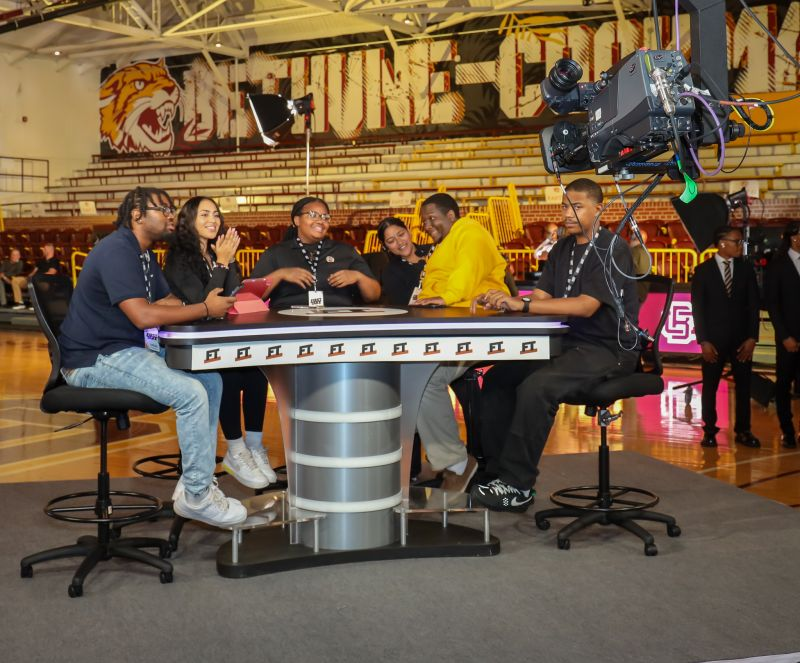
Bethune-Cookman students participate in an ESPN First Take production workshop • Image source: Bethune-Cookman University
One of the most important HBCU sports-media stories of 2026 may not be happening on a field.
It is sitting inside federal legislation.
Title III of the revised Protect College Sports Act creates an HBCU Sports Media and Connectivity Program that would support broadband, information technology, media infrastructure and the systems used to produce, transmit and distribute live intercollegiate athletic coverage.
The bill has not become law. But the scale of the proposal makes the media provision worth watching now.
The proposal at a glance
Maximum annual authorization for the HBCU Sports Media and Connectivity Program.
Funding authorization window: fiscal years 2027 through 2032.
Maximum total authorization if the full annual amount were funded across all six years.
The section of the Protect College Sports Act specifically dedicated to HBCU media and connectivity.
The infrastructure behind the picture
PRODUCTION — cameras, audio, replay, graphics systems and control-room equipment.
CONNECTIVITY — broadband and network capacity required to move live video and large media files reliably.
DISTRIBUTION — tools and systems used to transmit and publish live intercollegiate athletic coverage.
LEARNING — infrastructure that can also support student journalism, production training and campus media.
A broadcast investment can become a whole creative-department upgrade
The same cameras and edit systems used for live sports can support recruiting, coach shows, athlete profiles, podcasts, social video and sponsorship content.
For smaller HBCU departments, infrastructure dollars could strengthen several parts of the operation at once instead of improving only the game stream.
This is the maximum six-year authorization if the bill passes and Congress later funds the full annual amounts. It is not money already awarded to HBCUs.
IMPORTANT: The legislation creates an authorization framework. It does not guarantee that $1.08 billion will be appropriated or distributed.
Why this could matter to HBCU creative departments
At larger athletic departments, live production can be supported by dedicated control rooms, full-time creative staffs and specialized broadcast personnel.
At smaller institutions, the same responsibility may be spread across athletics communications, campus IT, student media and a handful of staff members.
Infrastructure investment can narrow that gap. It can make more sports viable to stream, improve visual quality and give creative teams better tools to tell stories between games.
Where the proposal stands
The Senate Commerce Committee advanced the Protect College Sports Act to the full Senate by a 19–9 vote.
Senate leaders released revised bill text that kept the HBCU Sports Media and Connectivity Program in Title III.
The legislation still needs further congressional action. Authorization would also not guarantee that every dollar is ultimately appropriated.
The most lasting outcome may be who gets trained on the equipment.
The program language includes local journalism and student learning alongside sports-broadcast infrastructure.
That matters because upgraded facilities can give HBCU students direct experience in camera operation, directing, replay, graphics, photography, editing, reporting and live-event production—the same skills used across professional sports and entertainment.
The value is not only a better stream today. It is a stronger media pipeline tomorrow.
The story is not the number. It is what HBCUs could build with the infrastructure.
The proposal has not become law, and the $1.08 billion figure should not be treated as funding already on the way.
What is significant now is that HBCU sports-media infrastructure has been written into a major federal college-sports bill at a scale large enough to change what campuses could build.
If the program survives the legislative process and receives funding, the result could show up in sharper broadcasts, stronger creative departments, better student training and more control over how HBCU stories reach the public.
More HBCU sports, design and culture from MFNGraphics.
© 2026 Made From Nothing Graphics LLC. All rights reserved.